

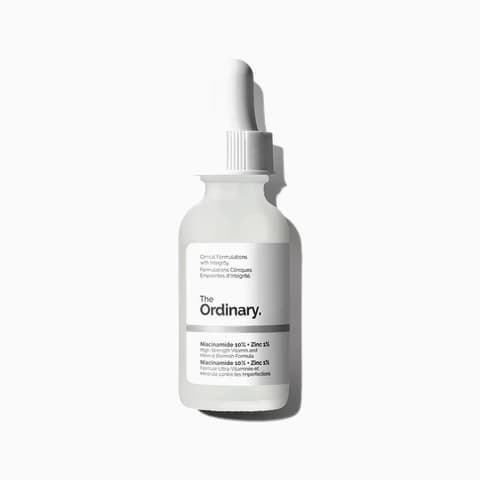
Comparison
Azelaic acid vs niacinamide
Two gentler ingredients frequently compared for marks, tone and sensitive acne-prone skin.
Quick verdict
Azelaic acid is often the comparison when post-acne marks, uneven tone or sensitivity are the main concern — it can help the look of redness and dark patches while still suiting many acne-prone routines. Niacinamide is the broader "support" active: oil balance, barrier support and mild mark care without the same targeted anti-mark profile. Many people use niacinamide daily and add azelaic acid when marks are the priority.
Side by side
 Azelaic acid Ingredient |  Niacinamide Ingredient | |
|---|---|---|
| Also known as | — | Vitamin B3, Nicotinamide |
| Often used for | Acne marks, Dark spots from acne, Shaving bumps, Sensitive acne-prone skin | Acne marks, Dark spots from acne, Sensitive acne-prone skin |
| What to know | Available over the counter at 10% in many countries; higher strengths are prescription-only in some markets. May suit both active breakouts and flat marks. | Generally gentle at 2–10%. Frequently combined with benzoyl peroxide, retinoids and acids. Not usually a sole treatment for moderate inflammatory acne. |
Detailed comparison
Azelaic acid is a dicarboxylic acid available in over-the-counter serums (often 10%) and higher strengths on prescription in some countries. It is often discussed for post-inflammatory hyperpigmentation, redness and blemish-prone skin that does not tolerate stronger acids.
Niacinamide (vitamin B3) appears in serums and moisturisers at roughly 5–10%. It is compared for sebum regulation, barrier support and the look of pores and marks, usually with a very gentle profile.
These ingredients are not rivals in every routine — they address overlapping but different jobs. Some formulas pair both; others introduce one at a time to see how skin responds.